What I build
Most AI content tools need a human at the keyboard for output. I build systems that don't. My most advanced build is a fully autonomous content agent: it produces, critiques, revises, and publishes content for a portfolio of 21 clients across 8 industries on a weekly schedule. No one triggers it. No one reviews it. It replaces $1,260 per month in production labour with $8 in API costs.
For businesses that want human oversight at every stage, I also build prompt-based content systems that handle topic research, drafting, SEO optimisation, and quality control inside a Claude workspace. Both types are custom-built for the specific business: industry, audience, voice, keywords. Both are handed over with full documentation and a live walkthrough. No ongoing dependency, no subscription to me. The content reads like it was written by someone who actually works in that field, because the system was built by someone who understands how to make that happen.
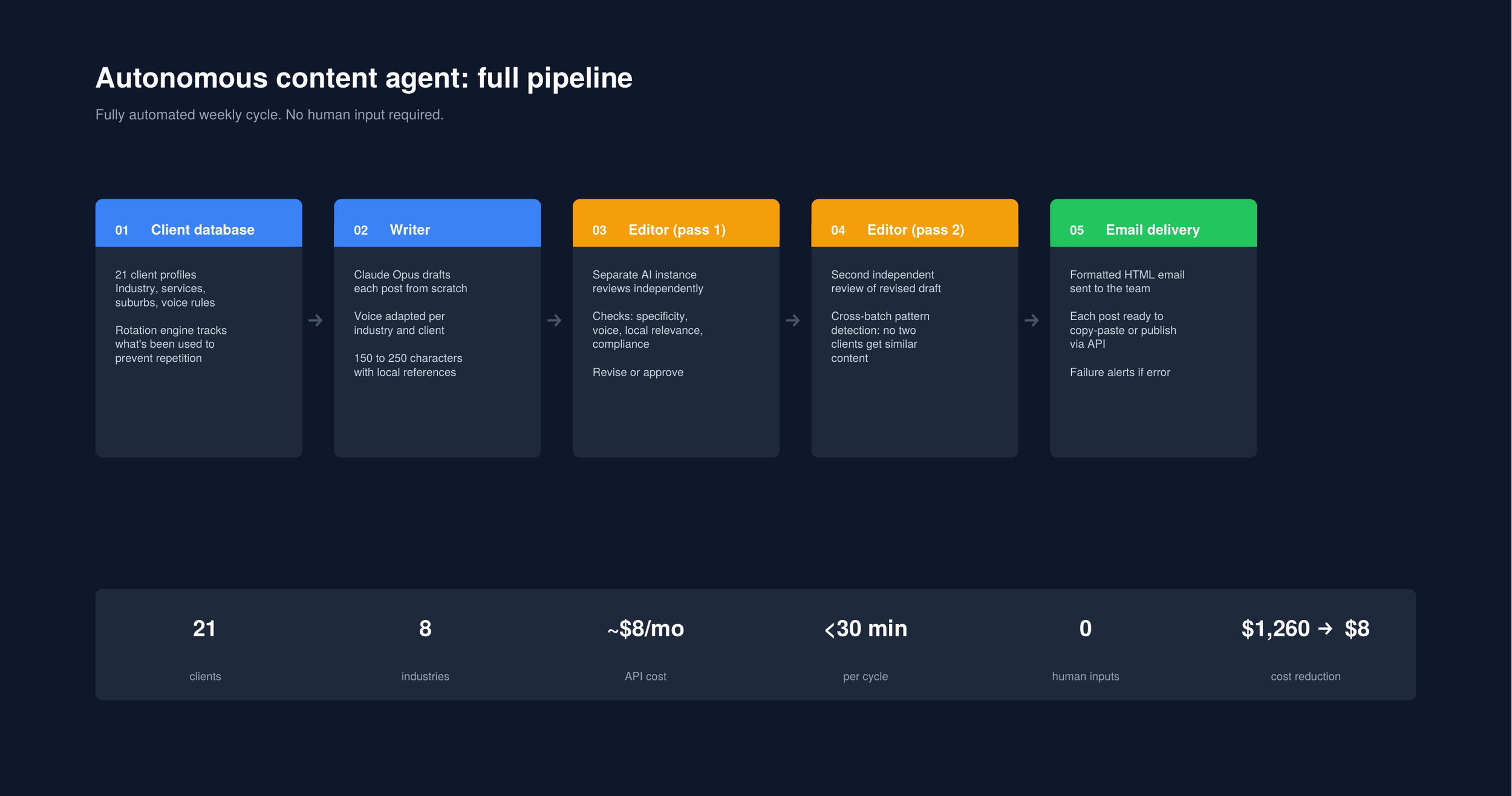
Autonomous agent: no operator required
Recurring content across a portfolio of clients is one of the most expensive repetitive tasks in a digital agency. This agent eliminates it. It runs weekly on a cloud server, writes content for each client in the portfolio, quality-checks every draft through an independent AI editor, and delivers the finished batch by email. No one triggers it. No one reviews it unless they want to. It was built for a Melbourne agency managing 21 clients across 8 industries. Their production cost dropped from $1,260 per month to $8.
Self-correcting quality
Every draft is evaluated by a separate AI instance running a different brief. It checks for specificity, voice accuracy, local relevance, and compliance. If the draft is generic or inaccurate, it goes back to the writer with feedback and gets rewritten. The revised version goes through a second editor pass before it's accepted. No single AI ever reviews its own work.
Adaptive voice
A mechanic in Moorabbin sounds like a mechanic. An accountant in Hawthorn sounds like an accountant. Most automation tools swap a business name into a template. This agent generates every post from scratch using the client's full profile, industry voice rules, and local context. The result reads like someone who works in that industry wrote it.

Zero repetition
The system tracks what's been written for each client: which suburbs, services, content categories and opening styles have been used. Every new post is different from the last. Clients in the same area and industry never receive similar content in the same period. Over months of production, the portfolio's content library grows without repeating itself.
Email delivery
The agent emails a formatted batch to the team each week. Each post is ready to copy and publish, with image guidance and metadata included. No files to download, no dashboards to check, no manual triggers. At handover, the agency owns the server, the code, and the credentials. No ongoing dependency.
Production system: 150 posts per month across 50+ clients
Most agencies hit the same wall. Content production is the biggest time cost in the business, but the work itself is repetitive: research a topic, check what's ranking, draft the article, match the client's voice, optimise for SEO, review for accuracy. Multiply that by 50 clients and 150 posts per month and you've got a team buried in production instead of doing strategy.
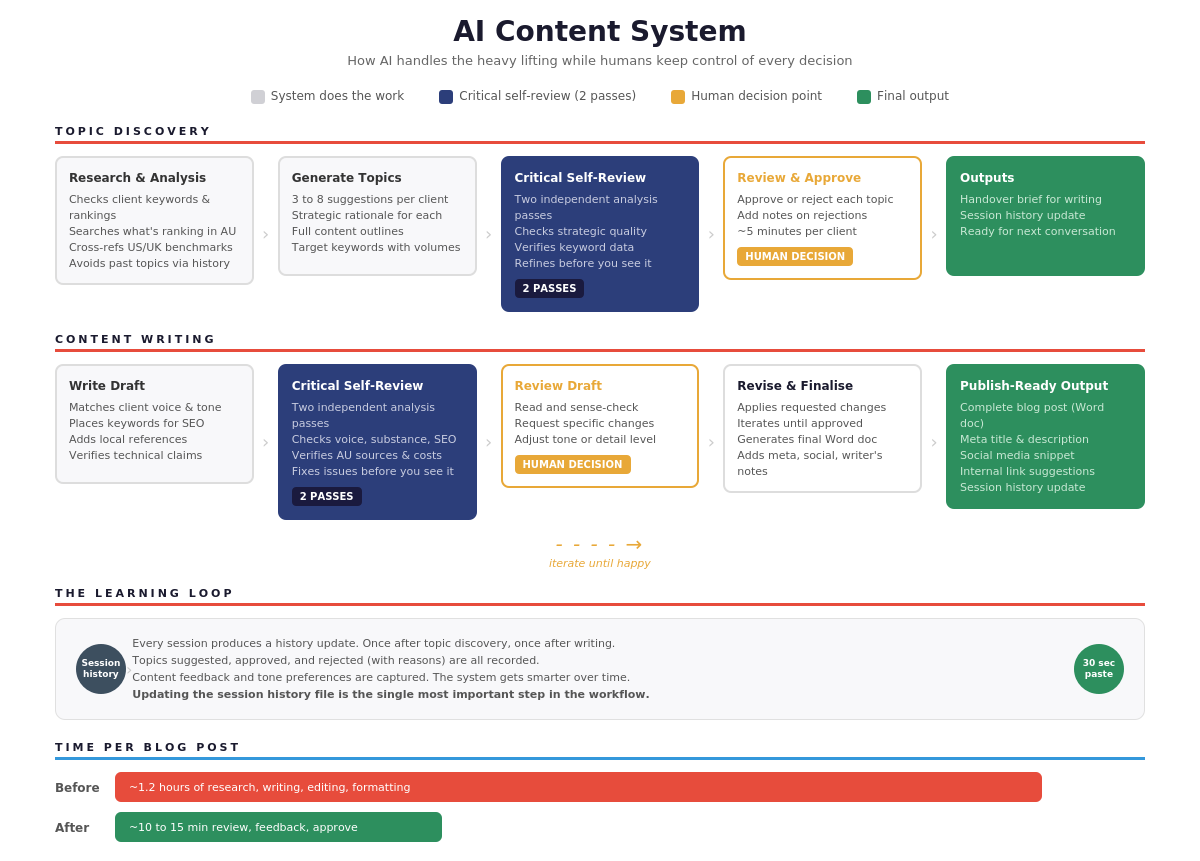
This system handles the entire production workflow. It researches what to write about using keyword data and competitor analysis, drafts complete articles in the correct voice for each client and industry, builds in SEO metadata, and runs its own critical analysis before a human sees it. The team's role shifts from writing to reviewing. Content that previously took 60 to 90 minutes to research and draft takes 10 to 15 minutes to review and approve.
It was built for a Melbourne digital agency producing content across more than 50 clients in multiple verticals. The core of the system is a multi-mode prompt architecture of approximately 3,000 words that orchestrates everything below.
Topic discovery
The system analyses keyword data, checks what's currently ranking in Australia, and draws on content benchmarks from overseas markets where content marketing is more mature. It produces topic suggestions with strategic rationale, full outlines, and target keywords with search volumes. The team reviews, approves or rejects, and moves on.
Voice switching
Six distinct audience profiles, each with its own tone, vocabulary, and register. The system adjusts its writing style based on which client and industry it's producing for, drawing on brand guidelines and example content. An article for a European car specialist reads differently from one for a panel beater, even though both are automotive.
Self-review
Before any content reaches a human reviewer, the system runs its own critical analysis. It checks for factual claims it can't verify, flags where it's being generic rather than specific, and assesses whether the piece would be genuinely useful to the target reader. For technical or regulated content, it cross-references claims against Australian sources via web search and notes where manual checking is needed.
Cumulative learning
After every session, the system produces a structured summary that feeds into a persistent history. It remembers what topics have been covered, what the client liked or rejected, and what feedback has been given. Over months of use, the system gets measurably better at matching what the team needs without being told.
The commercial impact
For a single business producing 8 posts per month, a system like this typically saves $7,000 to $11,000 per year in content production costs. For an agency producing at scale, the annual saving is in the range of $130,000 to $200,000. The system runs on a standard Claude Max subscription at $160 per month with no ongoing dependency on the person who built it.
Long-form production
I've used AI-assisted workflows to write two complete non-fiction books, designing the production architecture from scratch. Each book required its own system: chapter-by-chapter generation with voice constraints, continuity management across 300+ pages, and fact-verification workflows for book-length claims. The process taught me where AI content production breaks down at long range and how to design systems that compensate.
How I approach this work
I've spent significant time understanding how large language models work at an architectural level: interpolation, attention mechanisms, training dynamics, and the capabilities and limitations that follow from how these systems are built. Understanding why a model behaves a certain way is what allows me to design systems that work reliably rather than through trial and error.
My background in content strategy across regulated industries shapes how I build. I think about failure modes, compliance boundaries, and edge cases, because in a production environment, an AI system that's right 95% of the time and confidently wrong 5% of the time is worse than no system at all.