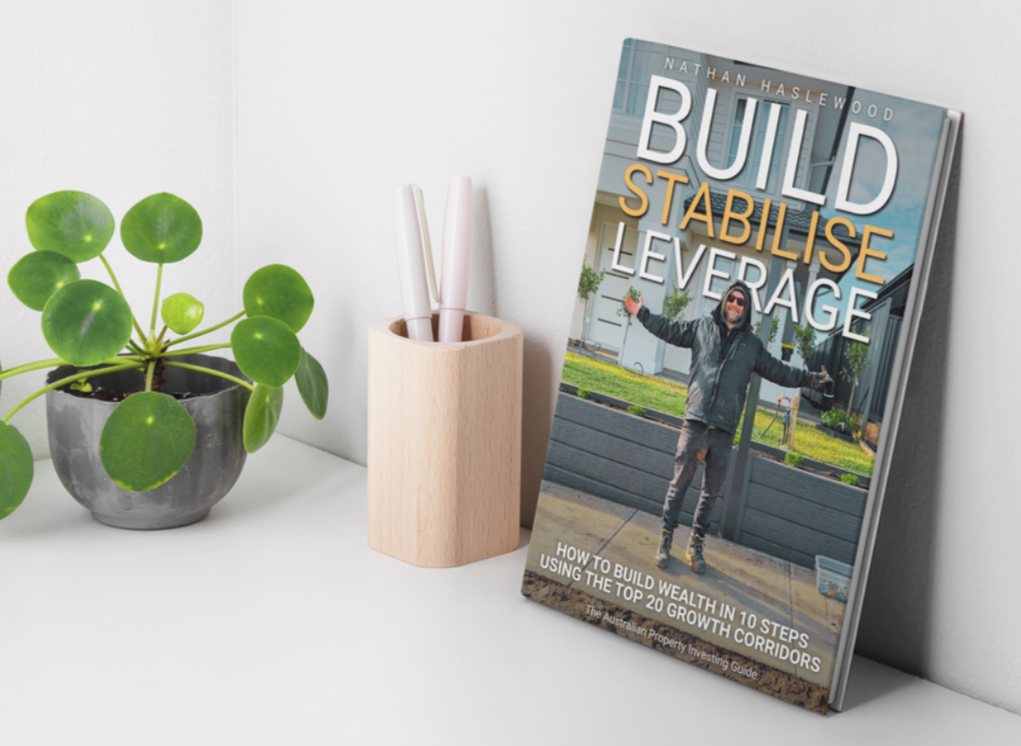
Introduction · page 8
This is your blueprint
My wife and I came to Australia ten years ago with nothing. Literally nothing.
Since then? Three properties. Two built. One renovated. One sold. I'm not a mogul. I'm just a regular guy doing a regular job. But I have created a lot of wealth through property in a relatively short space of time. And I've learned what works, and what doesn't, the hard way.
This is your blueprint. Both what I did right and what I did wrong. Straightforward principles. A clear structure you can follow on your own journey.
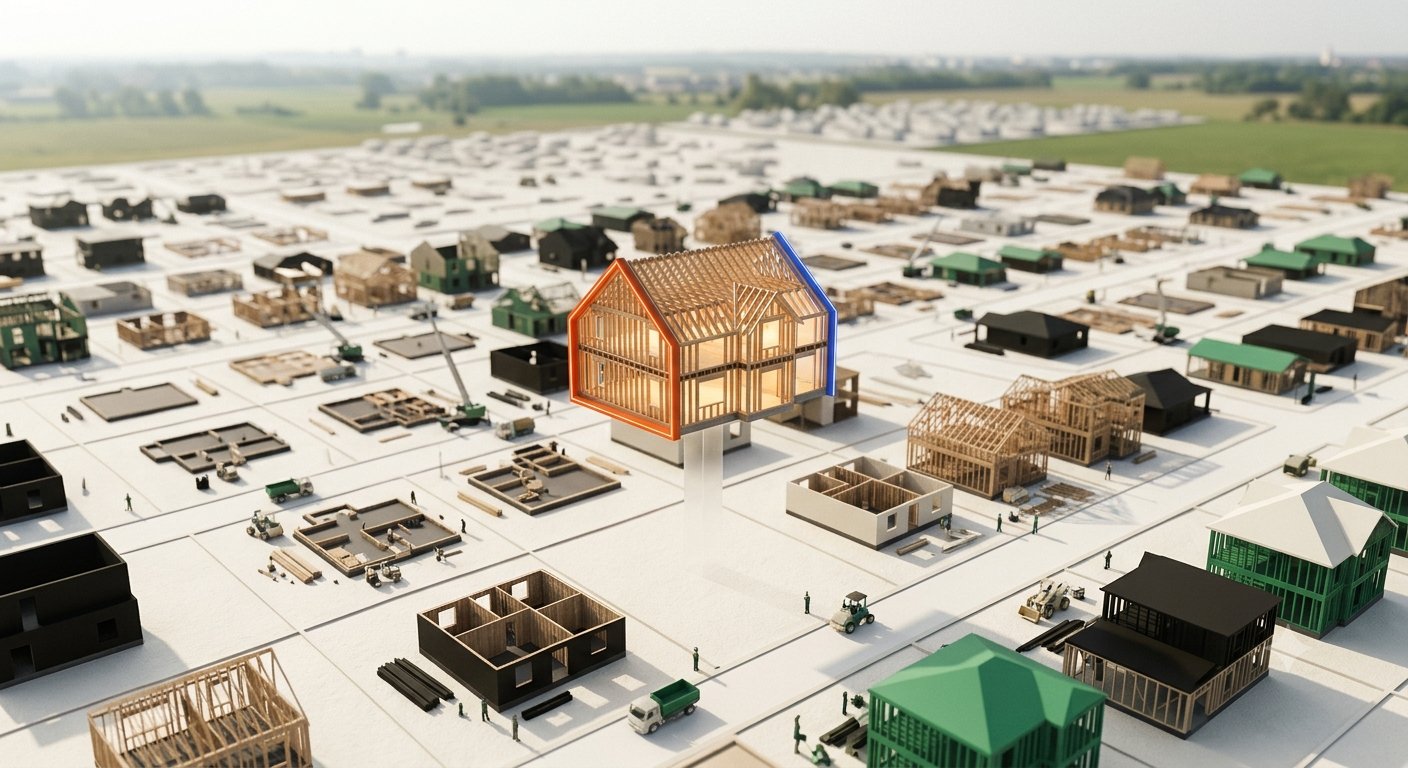
Build covers the first five steps. Where to build. How to build. How to renovate. And why. Stabilise is steps six, seven and eight. How to manage the disruption and cost of building or renovating without it wrecking your life. Leverage is steps nine and ten: financing, equity, deposits and strategies for making the very most of your efforts.
And finally, there's risk management. Because taking on leverage means taking on risk. It wouldn't be right to write a guide like this without helping you put guardrails around that risk. So you never become overextended. So you never get into trouble. So if you're facing redundancy, like I am right now, you won't need to panic.
This is the model I wish I'd had when I started. Now it's yours.
The introduction continues with who the book is for, and who it isn't.
Step 1 · Choose growth corridors · page 19
Structural growth, not hot tips
I just checked the value of our Tarneit house. $640,000. Eight years ago, we paid $370,000. That's $270,000 in equity.
I didn't time the market. I didn't get a hot tip. I didn't do anything clever. I just bought where the Victorian Government was spending billions on roads and trains as part of their Western Growth Corridor infrastructure program. That's called structural growth. And it's how you actually build wealth in property.
Structural growth happens when long-term trends push property values up regardless of what the economy is doing. It's not about timing the market. It's about positioning yourself where population growth, infrastructure investment, and government planning all line up in your favour.
Think of it like this: if you buy in a growth corridor, you're not betting on a hot tip or trying to pick the perfect moment. You're planting yourself in the path of inevitable expansion. The growth drivers are structural. They're baked into decades of government planning and demographic trends.
The government announces a $5 billion rail line. You buy before it's built. Five years later, it opens. Your property has doubled in value. That's structural growth.
The chapter ranks Australia's top 20 corridors and tells the unsanitised story of eight years living in one.
Step 2 · Always choose a mainstream builder · page 45
Six months early
Six months early. That's how ahead of schedule our Carlisle build finished. Not six months late. Not on time. Six months early.
Know why? I chose a mainstream builder. That's the only thing I did differently from my Russell Island disaster, where a small builder took two years and nearly convinced me I had no business being a property investor.
I've built two properties over the past decade. One was a nightmare that nearly killed my property investing career before it started. The other was so smooth I barely had to think about it. The difference? The builder.
Before I tell you what went wrong, let me tell you why I made the mistake in the first place. Because you're probably tempted to make the same one. Every mainstream builder in Brisbane told me: "We don't build on Russell Island. Too remote. Too difficult." Then I found a small outfit in Melbourne. Container homes. Innovative. Exciting. And $75,000 cheaper than the other quotes.
I thought I was being strategic. Saving serious money. Minimising my risk. I was wrong. That $75,000 I "saved" cost me two years of stress, countless sleepless nights, and nearly my confidence as an investor. The cheapest option turned out to be the most expensive.
Then the chapter walks the nightmare month by month, and gives the five-step builder vetting process that prevents it.
Step 3 · Renovate cheaply or slowly · page 66
The $30,000 pipe
$30,000. That's how much damage a single burst pipe caused while I was hiking in the Victorian Alps.
I had no phone reception. My wife came home on a Saturday morning to find our house flooded. Water pouring through the ceiling. Pooling across the brand-new timber floors we'd just installed. She ran out of the house in a panic, knocking on neighbours' doors, asking strangers for help.
By the time I got back and heard what happened, the damage was done. The ceiling of our second bathroom had collapsed. The timber flooring throughout the whole house: destroyed. And the worst part? It was our fault. We'd cut corners. We didn't have enough money to use a certified plumber when we renovated that bathroom. We found someone cheaper. A few months later, a pipe in the roof burst, almost certainly connected to that work.
Insurance covered the $30,000 repair bill. It didn't cover the weeks of living in a construction zone, or my wife dealing with all of it alone. We learned something important from that disaster: never cut corners on renovations. If something needs a certified professional, pay for a certified professional.
That lesson, learned the hard way in our first year, shaped everything we did for the next seven. Here's how we renovated our house for $52,500, slowly and steadily, without ever making that mistake again.
The chapter's rule: facelifts, not gutters. It shows exactly where the money went.
Step 4 · Get guarantees from family · page 82
The $100,000 that changed everything
$100,000. That's what my wife's parents lent us to buy our first home.
Without it, we couldn't have bought Tarneit. We didn't have enough saved. Our incomes weren't amazing when we first moved to Australia. We would have been stuck renting for another three to five years, probably forced into a unit instead of a three-bedroom house with a backyard. Their generosity changed everything for us.
We've since paid back every cent, through the profits from Russell Island and by refinancing Tarneit. It took years. But we did it. I'm incredibly grateful. I always will be.
But here's what I've learned since, particularly from my time working on home loans at ANZ: there was a better way. A family guarantee would have given us the exact same head start, getting into the market years earlier, without the burden of repaying $100,000.
For years, the debt sat in the back of my mind. Every financial decision I made, I was aware of it. It wasn't stress exactly. It was more like weight. A constant awareness that we had an obligation to fulfil. This chapter is about the better way. And why most Australian families don't use it.
The chapter compares the loan we took with the guarantee we should have used, dollar for dollar.
Step 5 · Do landscaping yourself · page 96
$300 and two hours
I was sitting in a hotel room in Melbourne's CBD. 9pm. Still working. I'd been working round the clock for two weeks straight rescuing a Victorian Government website project with an impossible deadline.
My phone rang. My wife. Sobbing. "Rocko's gone. He's dug under the fence. I can't find him. I've been walking the streets for an hour calling his name."
I sat there in that hotel room, listening to her cry, and there was nothing I could do. I couldn't leave. The deadline couldn't move. Eventually, she found him. Someone had posted on Facebook. Crisis averted.
But here's the thing that still haunts me: if I'd spent $300 on chicken wire and two hours burying it around the base of our fencing, none of that would have happened. $300. Two hours. The cheapest, simplest solutions often prevent the biggest problems. And that's exactly what DIY landscaping is about.
$44,200. That's what professional landscapers quoted me to landscape our Mount Atkinson property. I spent $26,150 doing it myself, and I got exactly what I wanted. Labour is expensive. Your labour is free. And here's what nobody tells you: landscaping is actually fun. Singular physical tasks with tangible results. Completely off screens.
The chapter breaks the $26,150 down line by line, including what failed.
Step 6 · Live in it yourself · page 125
The biggest tax advantage in Australian property
Living in your investment property is the simplest strategy in this book. You can't go wrong. You're your own tenant, so you can't have bad ones. You can landscape and renovate as slowly as you want. You can spread the cost and complications so they don't wreck family life, health, or lifestyle.
And here's the beautiful part: improving it to your own standards pretty much guarantees you can take a rundown house and make it a beautiful home for future tenants. Just turn it into the kind of house you want to live in.
Living in your property first also unlocks the single biggest tax advantage in Australian property investment. If you live in a property for the entire time you own it, you pay zero capital gains tax when you sell. Zero. This is called the main residence exemption. And it's huge.
Say you buy a property for $400,000 and sell it ten years later for $700,000. That's a $300,000 capital gain. If it was an investment property the whole time, you'd pay tax on that $300,000 as if it were income. Even with the 50% discount for holding over 12 months, that could easily be $50,000 to $75,000 in tax.
But if you lived in it the whole time? Zero tax. You keep the entire $300,000.
The chapter then explains the six-year rule: how to move out and keep the exemption.
Step 7 · Get a happy, long-term tenant · page 134
Five minutes before the inspection
I was on my knees in the mud, screwing a house number into a plank of wood. The inspection was starting in five minutes.
The front yard was still a construction site. No lawn. No path. Just dirt and chaos. We didn't even have a visible street number, which meant potential tenants had no way of finding the place. I'd realised this about twenty minutes earlier. Panic.
So there I was, drilling our house number onto a piece of timber while my wife watched from the doorway. I didn't even have time to hammer the plank into the ground properly. I just leaned it against a fence post and hoped it wouldn't fall over. Five minutes later, the first car pulled up.
Fifteen groups came through that afternoon. Young couples. A family with kids and grandma. Professionals in neat clothes. We weren't supposed to be there. Most landlords let the agent handle inspections. But we wanted to see who might be living in our house. You can learn a lot in five minutes: how people treat your property, whether they take their shoes off, whether they ask thoughtful questions.
The tenants our property manager recommended? They've been perfect. Pay on time every month. Look after the place. Zero drama.
The chapter argues boring is the goal, and shows the real numbers behind a happy tenancy.
Step 8 · When to use short-term rentals · page 142
The honest maths
If you've followed my advice and bought in a growth corridor, you can probably skip this chapter.
The numbers often don't stack up. Our Tarneit property earns $19,216 per year net with a long-term tenant versus just $8,248 with short-term rentals. That's $11,000 less for more work, more stress, and more regulation. Growth corridors aren't tourism hotspots. Nobody's booking a romantic getaway in Wyndham or Melton.
But there are situations where short-term rentals make perfect sense. Tourist hotspots. Beach towns. Regional areas near wineries or national parks. The key is knowing when the numbers work and when they don't.
Here's the opportunity cost, honestly. Option one: chase short-term rental income. Pay 15 to 25% management fees, deal with regulations and uncertainty, maybe earn 20 to 40% more than long-term rent if you're in the right location. Or maybe earn less after all fees and hassles, like my Tarneit example.
Option two: buy another investment property in a growth corridor with a long-term tenant instead. Predictable rent. Zero hassle. Capital growth working on multiple properties. For most investors, option two is smarter. Two properties compounding in growth corridors will build more wealth than one property trying to squeeze extra rent from short-term guests. That's the boring, proven, wealth-building strategy.
The chapter names the exceptions, and the towns where the maths flips.
Step 9 · Equity and negative gearing · page 170
Matt's phone call
Matt called me in late 2024, buzzing with excitement. "Mate, you need to see this."
He pulled up his banking app and showed me his property value estimate. His Logan Reserve investment, purchased for $429,000 in 2019, was now worth approximately $800,000. $371,000 in equity. In five and a half years. "Not bad for $420 a month out of pocket," he grinned.
He'd done something that terrifies most first-time investors: borrowed 108% of the purchase price, used every dollar of equity from his existing property, and bought into a growth corridor with zero deposit. On paper, he was losing money every single month. Negative gearing, the accountants call it. In reality, he was building serious wealth.
Equity is the difference between what your property is worth and what you owe on it. That number isn't just paper. It's a tool. The bank will let you borrow against it. This is how ordinary Australians build property portfolios without saving massive cash deposits.
We bought Tarneit for $370,000. Eight years later it was worth around $640,000. We didn't need to sell to access that wealth: the bank let us borrow against the increased value, and that equity became part of our deposit for the $1.1 million Mount Atkinson build. Tarneit? Still ours. Still growing. That's leverage in action.
The chapter explains both tools properly, including when negative gearing is a trap.
Step 10 · When to sell · page 181
The equity that wasn't mine to use
I'll never forget the phone call with my mortgage broker about Russell Island.
It was 2024. The property had grown nicely. Bought for $200,000, now worth around $270,000. I wanted to refinance and pull some equity out for the next investment. I was expecting the usual deal: 80% loan-to-value, maybe even 90%.
"Sorry," the broker said. "Properties under 40 square metres, we can only do 60%." What? "It's a bank policy. Tiny homes under 40 square metres. And Russell Island is classified as a remote location. The combination means maximum 60% LVR."
My stomach dropped. I'd just realised that most of our family's cash was locked inside a property I couldn't leverage. The equity wasn't mine to use. It was trapped.
The trapped equity was frustrating, but I could have lived with it if everything else had gone to plan. It hadn't. I'd bought Russell Island planning to run it as a short-term rental. Then one management agency after another said no: too remote, not enough tourist traffic. Long-term tenant it was, at about half the projected return. Sometimes the smartest move isn't holding forever. Sometimes it's selling strategically and putting that capital somewhere better.
The chapter gives the sell/hold framework I wish I'd had, and how the sale still came out ahead.
Section four · Risk management · page 191
The most uncertain week of my career
I'm writing this during the most uncertain week of my career.
I've got a three-year-old son. Significant debt across our properties. A wife who's watching me think about this every single day. So you'd think I'd be panicking. But I'm not. I'm worried, sure. But I'm not lying awake at 3am thinking we're going to lose everything.
Want to know why? Because we have six months' worth of expenses sitting in our offset account. Because my wife has a stable income. Because we're not maxed out on leverage, desperately trying to service loans we can't afford. Because we did the boring, unglamorous work of risk management.
Everything you've learned in this book, choosing mainstream builders, renovating smart, picking growth corridors, using equity wisely, all of that wealth creation can evaporate in a single phone call if you haven't protected yourself.
Let me tell you what six months of expenses actually means. Not six months of mortgage payments. Not six months of "essentials". Six months of everything. Mortgage. Food. Bills. School fees. Car rego. Insurance. Netflix. Coffee. Everything. Work it out. Right now. Multiply by six. That number needs to sit in your offset account. Not in shares. Not in crypto. In your offset account, attached to your mortgage, reducing your interest while staying completely liquid.
This section isn't sexy. It might save your skin when life happens.
Appendix · Australia's top 20 growth corridors · page 211
Corridor file #1: Western Sydney Aerotropolis
The opportunity: Australia's biggest infrastructure project. Western Sydney International Airport construction is complete and on track to open late 2026. A brand new city built from scratch. 200,000 jobs by 2050. This is once-in-a-generation transformation.
The numbers, as at publication:
- Median house price: $950,000 to $1.1m, rapidly rising. Entry point: land from $400k, houses from $850k
- Population: currently 7,000, projected to reach 200,000 by 2050
- Sydney Metro Western Sydney Airport line: around $11 billion total, with $5.19 billion from the Federal Government
- Aerotropolis masterplan: 11,200 hectares of coordinated development, with Boeing and Northrop Grumman already committed
Timeline: buy now, before the airport opens and jobs start flowing. Peak growth expected 2027 to 2035. Hold long-term: this is a 15 to 20 year transformation.
And the risks, because every corridor file includes them: flight path noise, a decade of construction chaos, possible infrastructure delays, and a speculative market that could overheat then correct short-term.
One of twenty corridor files in the book, each with suburbs, tenant profiles, what to buy and what to avoid.